Essential Condenser Coil Maintenance Tips & Instructions for Refrigerated Containers
Refrigerated containers provide extremely reliable and economical solutions for your cold storage needs. What most people don’t realize is that the condenser coil needs routine maintenance. However, with a little regular care, your container will continue to operate efficiently for years to come.
Here are a few condenser coil maintenance items and reminders to ensure reliable service from your refrigerated container:
✅ Keep the Condenser Coil Clean
With any refrigeration system, keeping the condenser coil clean is essential to optimal performance. Dirty coils can lead to reduced efficiency, increased energy usage, and even premature compressor failure, which can cost thousands of dollars to replace. It’s recommended to clean the coil at least four times per year. A quick visual inspection will tell you if it needs more frequent attention.
Please refer to the instructions below, or feel free to contact us with any questions about coil cleaning.
✅ Repair the Unit with OEM Parts
Always use factory-replacement parts when repairing your unit. Maintaining OEM standards ensures proper performance and simplifies troubleshooting. Altering or modifying components can make diagnostics more difficult and potentially void warranties. We keep many parts in stock and can usually ship the next business day.
✅ Evaporator Coil Icing
Just like walk-in freezers, the evaporator coil in your refrigerated container can occasionally ice over, especially with frequent or prolonged door openings. Ice buildup blocks airflow and stresses the compressor. If icing occurs, remove products, open the rear doors, and run the unit in heat mode to thoroughly thaw it. Also, check that the drain tube is free of clogs, and remove the top rear evaporator cover for better airflow during thawing.
Why Coil Maintenance Matters
Over time, dust, debris, and grease can build up on the coil, restricting airflow and forcing the system to work harder. If neglected, this buildup can lead to:
• Decreased energy efficiency
• Inconsistent cooling performance
• Higher electricity costs
• Risk of major component fails
• Costly Breakdowns
🧊Instructions: Three-Phase Condenser Coil Maintenance
Here are three example photos below of the machine’s coil being maintained.
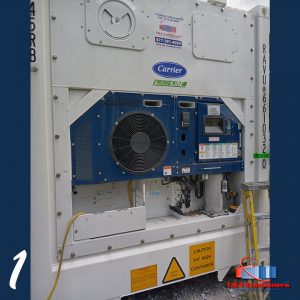

- The first picture above is a standard Carrier unit and what it looks like before cleaning.
- In the second picture above, you can see where the panel has been removed. You can see the dirty coil and a bird’s nest that has found a home!
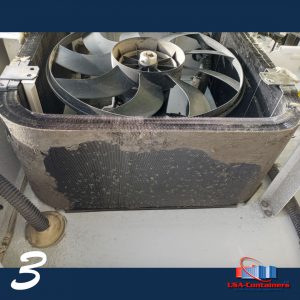
- Lastly, the third picture above shows a dirty coil up close.
Instructions:
7.10.1 Condenser Coil Cleaning To ensure optimal efficiency of the unit the condenser coil must be clean. The condenser coil should be cleaned at least once a year. More frequent cleaning may be required depending on operating conditions. Clean the coil with fresh water sprayed in the reverse direction of the airflow to remove any debris from the coil. Using mains water pressure is sufficient, high-pressured water is not required. To clean the condenser coil, perform the following procedure:
! WARNING! Do not remove the condenser fan grille before turning the power OFF and disconnecting the power plug.
1. Make sure the unit is powered off and the plug is disconnected.
2. Remove the condenser fan grille.
3. Starting from the top of the coil, use a water hose with a nozzle to wash the coil from the inside out.
4. Systematically wash across the inside top face of the coil until the water runs clear. 1 2 3 4 5 6 7–17 T-363
5. Wash down the center section, and then through the bottom of the coil, continue washing until the water runs clear.
6. After the coil is clean, rinse the condenser fan to remove any dirt build-up from the blades.
7. While ensuring that it is centered around the fan, replace the condenser fan grille.
8. Log your maintenance date and any issues found for tracking.
🧊Instructions: Single-Phase Condenser Coil Maintenance
As part of our growing lineup of cold storage solutions, we now offer Single-Phase refrigerated containers — ideal for smaller facilities, remote locations, and operations without access to Three-Phase power. These units deliver reliable, efficient cooling, but like all refrigerated containers, they require regular care to stay in peak condition.
One of the most important maintenance tasks is condenser coil maintenance. A clean condenser ensures your system can cool effectively, maintain temperature accuracy, and avoid overworking the compressor — which can extend the life of your unit significantly.
Quick Coil Cleaning Checklist
Here’s a simple maintenance routine you can follow every 90 days (or more often in dusty environments):
1. Turn off power to the unit before cleaning.
2. Inspect the coil visually for dust, dirt, or grease buildup.
3. Use compressed air or a soft brush to gently remove surface debris.
4. For deep cleaning, apply a coil cleaner solution (non-corrosive) as directed.
5. Rinse with low-pressure water — avoid soaking electrical components.
6. Allow the coil to dry completely before restoring power.
7. Log your maintenance date and any issues found for tracking.
📞 We Offer 24/7, 365 Free Support
Need help with your Condenser Coil Maintenance? Call us anytime. You’ll always speak with a real technician – no chatbots, no call centers. Press #2 for emergency support if it’s after-hours and urgent.
👉 Call us at 877-391-4064
